Journal of Mathematics, Energy Systems & ICT (MSTIC)
MSTIC es una revista científica de acceso abierto publicada por las Presses universitaires del Institut Universitaire des Sciences (P‑IUS). Revista semestral (2 números al año). Publica investigación original revisada por pares, números temáticos y también puede aceptar monografías y volúmenes colectivos académicos.
Submit ArticleArchives
Digital Transformation of Financial, Educational, and Health Services in Haiti
Vol. 1 No. 1 (2025)
This inaugural issue of Mathematics, Energy Systems and ICT highlights a major shift currently reshaping Haiti: the digital transformation of essential services and its implications for economic performance, information-system effectiveness, and equitable access. Drawing on empirical surveys and applied analyses, the contributions present ICT not only as a technical layer, but as a socio-institutional infrastructure. Digital tools can improve efficiency, lower certain barriers, and stimulate innovation, yet they also expose persistent weaknesses related to interoperability, data governance, digital literacy, and unequal access.
A first thematic strand investigates the digitalization of financial services and its impact on local economic activity. The study on banking service quality in Jacmel shows that digitalization can support SME performance—particularly by improving turnover—in a setting characterized by scarce credit and payment dysfunctions. Complementing this, the paper on mobile money examines the drivers of adoption as a pathway to financial inclusion, stressing both its capacity to reach unbanked populations and the structural constraints that remain (infrastructure, regulation, digital education). The discussion points to tensions across stakeholders and underlines the need for better coordination so that innovation translates into equity gains.
A second strand focuses on health information systems and the sustainability of digital solutions in constrained environments. The assessment of HIS in Carrefour reveals data fragmentation, interoperability barriers, and substantial needs in infrastructure and training. It also emphasizes the importance of the legal framework for medical data protection and the strategic role of backup and business-continuity planning—key conditions for reliable and sustainable electronic medical record management.
A third strand addresses ICT in higher education through the lens of the digital divide. The articles show that the effect of digital tools on academic performance is multidimensional: beyond usage, outcomes depend on living conditions, socioeconomic profiles, prior schooling, learning methods, and study contexts. The analysis of teachers’ practices and perceptions further identifies contributions, obstacles, and practical recommendations for more effective, better supported, and better governed pedagogical integration.
Overall, the issue advances a clear message: digital transformation in Haiti will not succeed without robust data governance, targeted investments (infrastructure and training), and coherent public policies capable of reducing the digital divide while improving service quality.
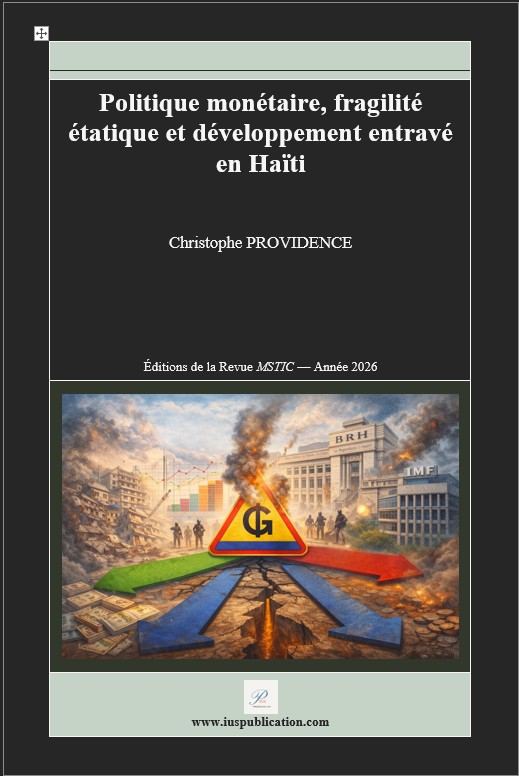
Monetary policy, state fragility and hampered development in Haiti (Academic book) - Professor Christophe Providence
2026
How can the currency of a country in crisis be stabilised without suffocating its economy? How can the state be financed without causing inflation? How can we support growth when the priority remains the defence of the water bottle? Between 2020 and 2025, the Bank of the Republic of Haiti had to juggle these impossible dilemmas, in the midst of a succession of shocks: pandemic, earthquake, growing insecurity, soaring global prices.
This book offers an unprecedented dive behind the scenes of Haitian monetary policy. It reveals the paradoxes of an institution caught between the pressure of international donors and the urgent needs of a society plunged into poverty. Stabilizing on the one hand, sacrificing on the other: this is the vicious circle in which the BRH has locked itself. But the book is not limited to an observation. It opens up perspectives, by showing that another path is possible: a monetary policy for development, capable of combining stability and support for the real economy. Adjusted monetary sovereignty, selective financing of strategic sectors, financial inclusion, regional cooperation: these are all concrete ways to transform a defensive currency into a lever for reconstruction and social justice.
At the crossroads of economic analysis and citizen reflection, this book challenges researchers, decision-makers and the general public. It invites us to rethink monetary policy not as a matter for technocrats, but as a collective choice that engages the future of Haiti and its place in the Caribbean.
Data, AI and modeling: applications to complex systems
Vol. 2 No. 1 (2026)
This issue of the peer‑reviewed journal MSTIC focuses on “Données, IA et modélisation : applications aux systèmes complexes” through applied mathematics, engineering, energy systems and ICT research. We welcome reproducible contributions (models, datasets, parameters, protocols) with verifiable results and clear discussion of performance, security and impact. Papers may be experimental, computational or systems‑oriented, with applications relevant to Haiti and emerging economies.
Submission
Image
e-ISSN: 3135-0909
p-ISSN: 3135-0895